
The train game

Is there an element of masochism among those who prefer to travel in India by train?
Maybe, but I prefer to think of it as a challenging board game, with many stressful but ultimately rewarding moves.
The board circuit for each train journey and the moves required for a satisfactory outcome follow the same basic structure, but each experience is at least slightly different. The always-present danger is that you will miss your train, most likely through no great fault of your own.
Starting with your first circuit of the board in Kolkata has a certain historic resonance that will align your inner nomad with the souls of every colour and culture that have ever moved from one place to another in India.
For Howrah Station was where it all began, 170 years ago, when the British built the first Indian Railway from Howrah Station to Hooghly Station.
As the scribes of the Indian Rail Catering and Tourism Corporation (IRCTC), put it so eloquently:
One line, one platform, one red brick room, one ticket window and just one train adds up to the neo-natal stage of train operations in Eastern India.
By the time we got there, there were 23 platforms, from which leave 772 trains a day, including 272 inter-city trains and 500 suburban EMUS (electric multiple units).
The night we left the YMCA Seacom Inn, we joined the throng of more than 23 million passengers a day who use the trains. I actually find that exciting — however also daunting. One of India’s unique opportunities is to temporarily join the most populous nation on earth and find out what it feels like to be one in a billion.
Our Uber driver dropped us off outside the main entrance of the multi-towered red brick colossus and graciously teed up a porter for us — actually a porter services manager who gave us a price (300 rupees as I recall) and an actual luggage-lugging porter.
Having arrived at platform number one and trusting our train left from either 21 or 22, we decided to take the offer, as the porter had a trolley and we didn’t. Besides we were too overawed to imagine we could cope on our own. It was a 20 minute walk through a churning mass of train travellers to get to the vast enclosure known as the “New Complex”, which houses platforms 16 to 23.
Choosing your platform is the point where the game usually starts. There are so many hundreds of trains zooming around the railroaded arteries of the subcontinent, like little corpuscles, that fine tuning their movements is a complex process. If a single train is late for any reason it can hold up a line and force a perfectly innocent train to find a new track — and therefore a new platform at its next destination. This can all happen with only minutes to spare.
From your viewpoint, you may, for example, have two large suitcases and a few extra bags, and have taken a punt on a particular platform based on whatever advice you could get — from a railway official, the station master or perhaps an app like Find My Train. You may have arrived at the station early, having had to check out of your accommodation by 10 or 11, and have become quite settled on your chosen platform, usually one of at least eight. Then, finally, presuming you are paying attention, you hear the announcement — the same computerised woman’s voice you hear in every railway station in India, and delivered usually in three languages, thankfully including English: Your kind attention please. Train number …. is about to arrive on platform number ……
If that is not the platform you chose, which is quite likely, you have only the time that about to encompasses, plus the time that the train is scheduled to stop for at the particular station, to get to the right platform … but that is not all.
If you are lucky, there may be a lift you can catch to the overpass, which you have hopefully parked yourselves and your luggage nearby. If you are even luckier there may also be a lift going down from the overpass to the right platform. Or else there may be a long flight of stairs to one or both platforms. At this point you will hopefully have enlisted the acquaintance of a young, strong local person who will help you with one of the suitcases, or there may even be a porter handy …
So let’s assume you are on the ball. You have been listening carefully to the announcements and you have made to it the right platform, successfully avoiding a sustained spike in your blood pressure. Now you have to find your carriage! Indian trains can be up to 650 metres long, with as many as 24 carriages, and your booked seats exist in only one of those carriages. Your app may give you an order in which the carriages are placed, but that order may have changed … or possibly completely reversed. You could of course just get on the train anywhere, but that’s a last resort, as you definitely don’t want to be lugging luggage through the narrow corridors of up to 24 carriages, all festooned with feet hanging out from the side berths.
There are usually little illuminated message boards along the platform that tell you which carriage is where just before the train arrives, but we have found these to be unreliable. Sometimes there is a blackout, or construction work on the station. Sometimes the train is so long you don’t have time to go up and down the whole platform looking for your number.
Reflecting on all this, it’s not so remarkable that local people sometimes behave quite badly in train stations. They may barge into a lift about to go down to the platform before the people coming up from the platform have a chance to get out, or they may push in to get their luggage on the carriage first (even though they have reserved seats and the train has another ten minutes before departure). There is panic abroad at train stations. The key to successful and satisfying train travel, however, is Don’t panic!
In two three-month trips to India we have travelled on dozens of trains and never missed one. We did once catch the wrong train, but managed to get off it and catch the right one at the next station. And the funny thing is that some people — porters, especially — seem to have an instinct for picking the right platform and carriage halting point.
At our Howrah train, the first one of our current trip, we were a little nervous at the first move of the 2026 train game. We couldn’t get a clear indication of either the platform — 22 or 23? — or the carriage position. We didn’t trust our porter, who had blackened his reputation by asking 200 more rupees than the agreed price, but in the end he was right. Our carriage came to rest exactly where he had told us it would.
Hundreds of us piled into the vessel of our hopes and dreams, some with not much more than a blanket; others like us, humping 35 kg of gear.
And nothing can compare with the relief of finding your seat number on a long-distance Indian train. Soon we were sailing through the West Bengali night, blessed with a compartment all to ourselves for the first time in all our train travels. Rocking, rolling, riding, train bound for Bengaluru, many miles away. Who cares if you can’t sleep? You have traversed all your snakes and ladders, got all your pieces home, and successfully passed Go. You are inside the womb of Mother India, waiting to be born into your next adventure.
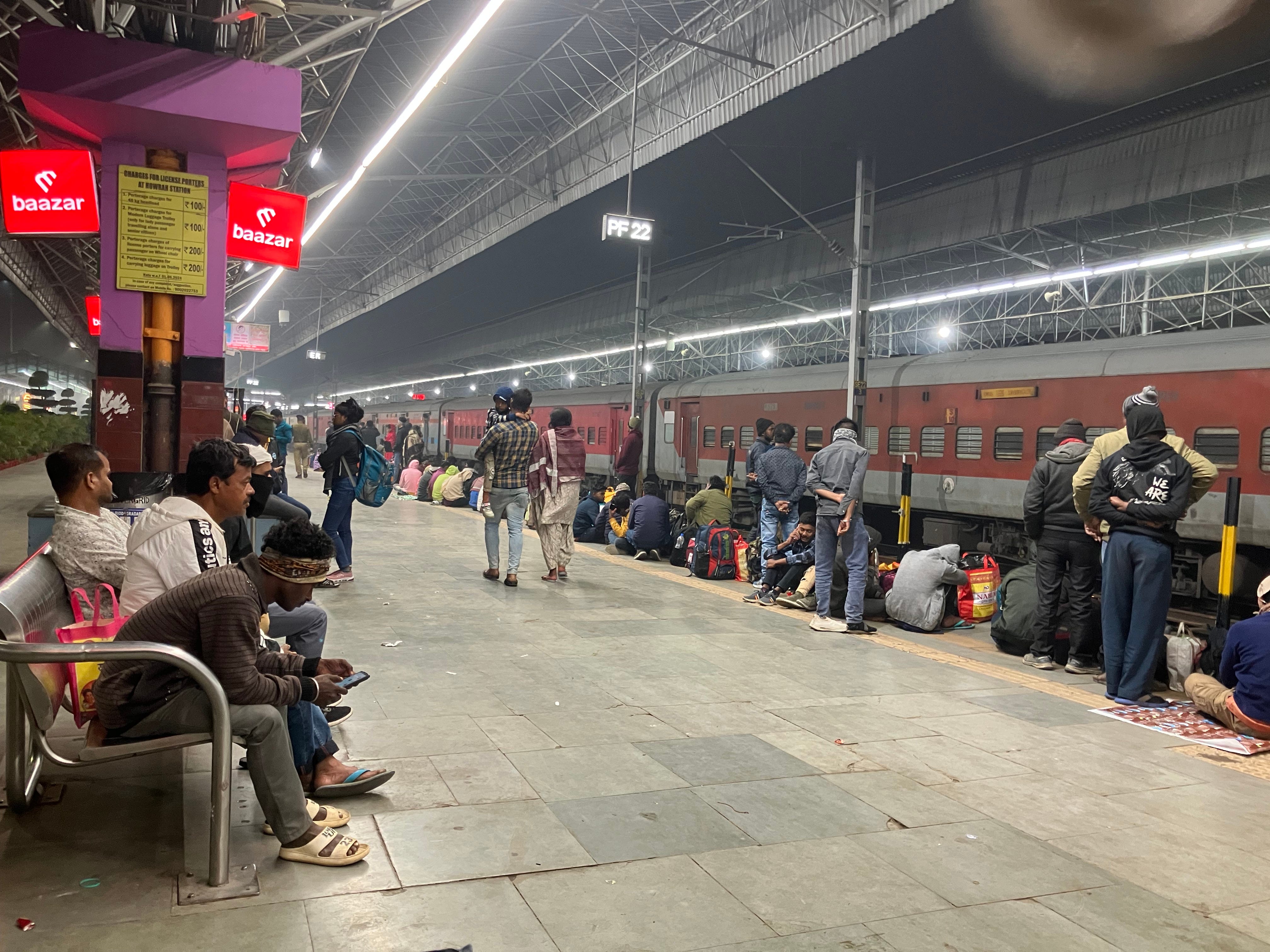
People wait for their train, Howrah Station, Kolkata
Wonderful :)